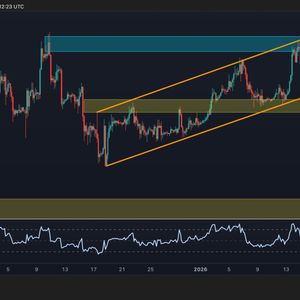
Ethereum remains in a corrective phase after rejection from the mid-$3,000 region, with the price rolling over on both the daily and 4-hour timeframes while on-chain data continues to show structural supply leaving exchanges. The combination of short-term technical weakness and longer-term constructive on-chain positioning creates a context where further downside or sideways action in the near term can coexist with a still‐intact cyclical bull backdrop. Ethereum Price Analysis: The Daily Chart On the daily chart, ETH has turned lower after failing to sustain inside the $3,300–$3,400 resistance block, which aligns closely with the downward-sloping 100-day moving average and remains below the slightly higher 200-day moving average. This rejection keeps the market capped within a broad range, with $2,500–$2,600 as the nearest significant demand area and the $3,300–$3,400 band as the primary supply zone whose reclamation would be required to re-establish a strong bullish trend. Daily RSI has also rolled over from near overbought territory and is now below 50, confirming a momentum slowdown consistent with a corrective leg toward the aforementioned support cluster. ETH/USDT 4-Hour Chart The 4-hour structure shows a clear breakdown from the ascending channel that had carried the price from the late-December lows toward the $3,400 area. After losing both the channel support and the intraday demand band around $3,000, ETH has accelerated lower toward $2,900, with the 4-hour RSI entering oversold territory, indicating stretched intraday conditions but not yet a confirmed reversal. As long as the asset trades below the former channel base and beneath the $3,000 region, the intraday bias remains corrective, with risk of extension toward the higher-timeframe demand around $2,500–$2,600 unless a swift recovery above $3,100 invalidates the breakdown. Onchain Analysis The exchange supply ratio for Ethereum has been trending steadily lower and now sits at the lowest levels of the past few years, indicating that a diminishing share of the circulating supply is held on centralized trading venues. This pattern typically reflects a gradual preference for long-term storage or staking over immediate liquidity, thereby reducing structural sell-side inventory even as prices undergo short-term corrections. Although lower exchange balances do not preclude further downside in the near term, such persistent outflows historically align with late-stage corrective phases within larger uptrends, where renewed demand can more easily translate into impulsive advances once macro conditions and technicals turn supportive again. The post Ethereum Price Prediction: How Low Can ETH Go After Losing $3K Support? appeared first on CryptoPotato .
LIVE
BTC
$90248.33
-0.41%
ETH
$3005.51
-0.82%
USDT
$0.9994
+0.02%
BNB
$890.25
-1.58%
XRP
$1.95
+1.58%
USDC
$1.00
+0.02%
Ethereum Price Prediction: How Low Can ETH Go After Losing $3K Support?
Crypto Potato
2 hours ago
ETH|EXCHANGE|MARKET|TRADING|CRYPTOCURRENCY
Related Articles

BTC|MARKET|TRADING|XRP|CRYPTOCURRENCY
Ripple Price Prediction: What Is XRP’s Next Move After 11% W...
Read MoreMarket Overview

BTC
Bitcoin
$90248.33
-0.41%

ETH
Ethereum
$3005.51
-0.82%

USDT
Tether
$0.9994
+0.02%

BNB
BNB
$890.25
-1.58%

XRP
XRP
$1.95
+1.58%