Alphabet’s Google has placed an order with Intel to produce over three million tensor processing units by year 2028, according to a report from The Information. Nvidia is also evaluating Intel’s technology for a multi-chip processor, though it has not committed to any order. If the deals are fully realized, this action would mark a big win for Intel’s chip business under CEO Lip-Bu Tan, who has spent the past year courting big tech customers to revive the company’s sales and production. Google and Nvidia look beyond TSMC Although the Taiwan Semiconductor Manufacturing Company remains in the driving seat regarding advanced chip production, surging AI demand has strained the leading producer’s capacity. This bottleneck is now pushing chip designers to seek solid alternatives. “This is evidence that AI’s biggest players are racing to diversify a supply chain still heavily concentrated in TSMC,” Jacob Bourne, a technology analyst at eMarketer, told Reuters. Google has continued to invest heavily in its own TPU silicon as an alternative to Nvidia’s GPUs. Manufacturing those chips through Intel rather than relying solely on TSMC would give Google a second production line for important hardware that has become central to the growth of its cloud revenue service. Nvidia’s interests are markedly different. The company is assessing whether Intel’s 18A process node can produce a package combining four graphics chips into one unit, and Intel would be useful in this process. No order has been placed, and Nvidia has not commented publicly. Intel beneficiaries of Trump admin The Trump administration has steered billions in incentives toward Intel, and Washington officials have actively encouraged other companies to use Intel’s products. “Beyond the standard need to diversify, Google and Nvidia are even more motivated than usual to work with Intel. Supporting Intel supports U.S.-based manufacturing, which is important for the relationship with the U.S. administration,” D.A. Davidson analyst Gil Luria told Reuters. Intel has already secured commitments from Nvidia ($5 billion) and SoftBank ($2 billion) in equity backing. Last month, the Wall Street Journal reported a preliminary deal for Intel to make chips for Apple devices. Tesla is also on board as the first announced customer for Intel’s next-generation 14A chips destined for Elon Musk’s Terafab AI complex in Austin. The numbers show mixed sentiments Intel shares climbed more than 9% in early Monday trading around $111, extending a run that has seen the stock gain roughly 196% year to date, according to Yahoo Finance. As recently as last June, shares traded near $20. The company’s Q1 2026 results showed revenue of $13.58 billion , with data center and AI revenue rising 22% over the past year to $5.05 billion and foundry revenue up 16%, Yahoo Finance reported. However, the foundry remains unprofitable, as Intel posted minus $3.87 billion in free cash flow last quarter, with Wall Street’s consensus price target sitting at $89, a number well below the current trading price. Analyst ratings are also cautious, with 31 Hold ratings versus 12 Buys and 5 Sells. The smartest crypto minds already read our newsletter. Want in? Join them .
LIVE
BTC
$63386.11
+2.43%
ETH
$1686.71
+3.62%
USDT
$0.9997
-0.01%
BNB
$605.95
+2.04%
USDC
$0.9998
-0.01%
XRP
$1.17
+3.83%
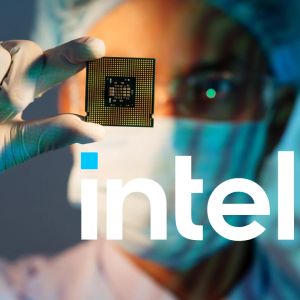
Google and Nvidia earmark Intel for backup chip supplier role
Cryptopolitan
2 hours ago
ASIA|BUSINESS|TECHNOLOGY|TRADING|CRYPTOCURRENCY
Related Articles

BUSINESS|FIAT|MARKET|TRADING|CRYPTOCURRENCY
Sportradar signed a multi-year data supply deal with predict...
Read More
BUSINESS|MARKET|RESEARCH|CRYPTOCURRENCY
ChatGPT gets optional security mode that cuts web access
Read More
ADA|BTC|BUSINESS|TOKEN SALE|CRYPTOCURRENCY
Cardano investigator demands answers from Charles Hoskinson ...
Read MoreMarket Overview

BTC
Bitcoin
$63386.11
+2.43%

ETH
Ethereum
$1686.71
+3.62%

USDT
Tether
$0.9997
-0.01%

BNB
BNB
$605.95
+2.04%

USDC
USDC
$0.9998
-0.01%