The darknet marketplace processed 640,000 cryptocurrency transactions across more than 400,000 buyer accounts before an exit scam shut it down in March 2024. Rui-Siang Lin, the 24-year-old Taiwanese founder of darknet drug marketplace Incognito Market, has been sentenced to 30 years in federal prison for operating a $105 million crypto-powered narcotics operation, the U.S. Department of Justice announced on Tuesday. Key Takeaways: – Lin received 30 years for running Incognito Market, which processed $105 million in cryptocurrency drug transactions between 2020 and 2024. – The platform used a proprietary crypto payment system called “Incognito Bank” to handle BTC and Monero transactions for over 400,000 buyers. – The sentencing arrives as the DOJ continues to prioritize darknet narcotics cases despite disbanding its dedicated crypto enforcement unit in 2025. U.S. District Judge Colleen McMahon, presiding in the Southern District of New York, called the case the most serious drug crime she had encountered in over 27 years on the bench, labeling Lin a “drug kingpin.” Lin pleaded guilty in December 2024 to charges including engaging in a continuing criminal enterprise, narcotics conspiracy, and money laundering. The court also ordered $105,045,109.67 in forfeiture. Operating under the alias “Pharoah,” Lin ran the marketplace from October 2020 through March 2024. He facilitated sales of more than 1,000 kilograms each of cocaine and methamphetamine, alongside hundreds of kilograms of other controlled substances, including fentanyl-laced pills linked to at least one overdose death. “Today’s sentence puts traffickers on notice: you cannot hide in the shadows of the Internet,” U.S. Attorney Jay Clayton said . “The internet, ‘decentralization,’ ‘blockchain’ — any technology — is not a license to operate a narcotics distribution business.” Proprietary Crypto Payment System Enabled Anonymous Drug Sales on Incognito Market At the center of Incognito Market’s operations was a custodial crypto wallet system called “Incognito Bank,” where users deposited BTC or Monero into on-site accounts, according to the DOJ. Transactions were processed internally between buyer and seller accounts, and the platform collected a 5% commission on every sale. According to court ruling details, Lin pocketed over $6 million in profits from fee compensations. In March 2024, Lin shut down the marketplace in an exit scam, stealing at least $1 million held in user deposits and threatening to publish transaction histories unless vendors paid extortion fees ranging from $100 to $20,000. The scheme revealed that the marketplace’s promised encryption and message deletion features had never functioned — user data had been retained throughout the platform’s entire operation. According to court filings, investigators traced Bitcoin from Incognito’s administrator wallet to Lin’s personal wallet, where it was converted to Monero and deposited into a centralized exchange account registered in his name, complete with his Taiwanese driver’s license and personal details. Lin’s Operational Security Failures Led to His Arrest at JFK Despite running a sophisticated darknet platform, Lin made critical mistakes that exposed his identity. He registered domains to promote Incognito Market using his real name, phone number, and physical address. One domain purchase was partially paid using 0.00501 BTC from a crypto exchange account containing his identity documents, directly linking Lin to the Incognito administrator wallet. He also maintained a GitHub account under his own name and saved the marketplace’s operational diagram to his personal Gmail. He was arrested at John F. Kennedy International Airport on May 18, 2024, while transiting to Singapore. The investigation involved the FBI, Homeland Security Investigations, the DEA, the FDA Office of Criminal Investigations, the NYPD, and U.S. Customs and Border Protection. DEA Special Agent in Charge Frank A. Tarentino III said Lin’s actions of prioritizing profits over public health were “reckless and dangerous, but unconscionable.” Sentencing Arrives Amid Shifting DOJ Crypto Enforcement Priorities Lin’s 30-year sentence stands as one of the harshest penalties for darknet marketplace operations. It’s second only to the life sentence initially given to Silk Road founder Ross Ulbricht — who was pardoned by President Trump in January 2025. In April 2025, Deputy Attorney General Todd Blanche issued a memo disbanding the National Cryptocurrency Enforcement Team and directing prosecutors to stop pursuing cases against exchanges, mixers, and wallets for the acts of their end users. US senators challenge @TheJusticeDept Deputy AG Todd Blanche over dismantling the crypto crime unit while holding $158K–$470K in $BTC and $ETH . #DOJ #CryptoCrime https://t.co/iTSjooq7Cq — Cryptonews.com (@cryptonews) January 29, 2026 However, the memo explicitly maintained focus on cases involving terrorism and narcotics trafficking — categories that squarely captured Lin’s conduct. Meanwhile, the DOJ has continued darknet enforcement on other fronts, finalizing a $400 million forfeiture tied to the Helix cryptocurrency mixer in January 2026. The post Incognito Market Founder Rui-Siang Lin Sentenced to 30 Years for $105M Crypto Drug Operation appeared first on Cryptonews .
LIVE
BTC
$73208.08
-4.25%
ETH
$2267.87
-2.05%
USDT
$0.9988
-0.06%
BNB
$728.54
-4.57%
XRP
$1.53
-3.93%
USDC
$1.00
+0.03%
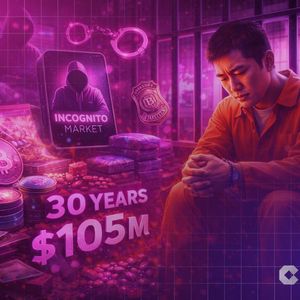
Incognito Market Founder Rui-Siang Lin Sentenced to 30 Years for $105M Crypto Drug Operation
cryptonews
1 hour ago
BTC|MARKET|XMR|CRYPTOCURRENCY|SECURITY INCIDENTS


Market Overview

BTC
Bitcoin
$73208.08
-4.25%

ETH
Ethereum
$2267.87
-2.05%

USDT
Tether
$0.9988
-0.06%

BNB
BNB
$728.54
-4.57%

XRP
XRP
$1.53
-3.93%